https://www.fda.gov/media/75713/download
Monoclonal antibodies are antibodies that come from a special hybrid parent cell, have the same variable and constant regions, and can thus recognize the same epitope. These antibodies are made by taking a lab animal and immunizing it to whatever is being studied, the resulting B cells that are made in the animal following immunization are then isolated and fused with myeloma cells. They are then fused together and placed in a medium that contains aminopterin (which myeloma cells cannot grow in the presence of), the B-cells and myeloma cells die, but the fused cells Hybridoma cells proliferate. The Hybridoma cells can then be selected against a specific epitope, and the consequent antibodies are monoclonal antibodies that can all recognize the same epitope.
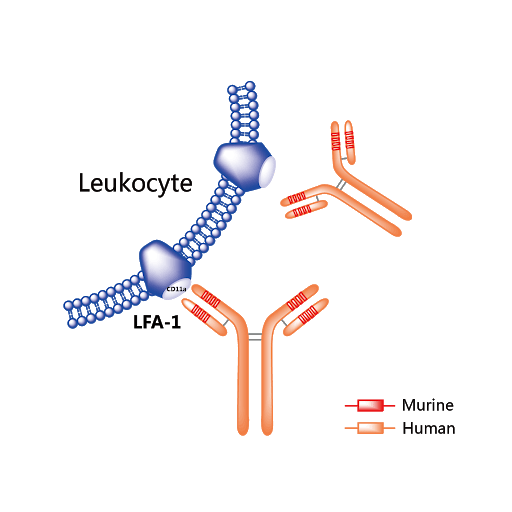
How does Efalizumab act against Psoriasis?
Efalizumab is a drug that is used for people who are afflicted with psoriasis, and is meant to reduce the signs of Psoriasis which primarily includes bumpy red, scaly patches on the skin. These red bumpy, scaly patches are caused by the activation of T cells that are present in the dermis, epidermis and in the circulation that trigger the release of the pro-inflammatory cytokines IL-12, IL-23 and TNF.
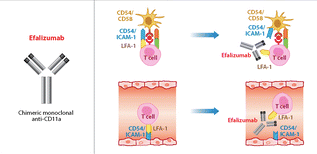
These lymphocytes are activate by binding to leukocyte function antigen-1 (LFA-1) that are expressed on lymphocytes. Efalizumab binds at the CD11a binding site (one of two binding sites on LFA-1 receptor) on the LFA-1 receptor disrupting and blocking the T-cells ability from binding and becoming activated. Without the availability of the CD11a binding site, T-cells are unable to become activated, are unable to travel through the periphery to psoriatic lesions and release pro-inflammatory cytokines and are unable to be reactivated in the skin of someone who has psoriasis.
What are the dangers associated with taking Efalizumab?
While this drug sounds promising, like many drugs it comes with a long list of side-effects. Side-effects of Efalizumab include:
-headache, fever, nausea and vomiting
-An increased risk for developing tumor and an increased risk of bleeding
-An increased risk of developing PML (progressive leukoencephalopathy)
-Risk of infection and reactive latent, chronic infections (because it’s an immunosuppressive agent) including pneumonia, sepsis, meningitis and encephalitis.
-Malignancies
-Immunosupression
-Immune-Mediated Thrombocytopenia
-Immune-Mediated Hemolytic Anemia
-Psoriasis Worsening
-Neurological Events (for example the development of Guillain-Barré Syndrome)
-Onset of Arthritis
Why are there so many dangers associated with taking this drug?
Many of these side-effects are a result of the fact that Efalizumab is an immunosuppressant, reducing ones ability to resist infections. This is because this drug reduces and inhibits the action of T cells which are an important component of our immune response and stops the usual inflammatory pathway that our body has, which impacts our ability to fight of external pathogens that we’re exposed to. Additionally, because it stops the release of several pro-inflammatory cytokines, which are used to fight off infections making individuals more susceptible to diseases and infections such as Tuberculosis, pneumonia and meningitis. This drug impacts aspects of both the innate and adaptive immune system, because it blocks the ability of T cells and their release of pro-inflammatory cytokines which results in the lack of cells of the innate immune system such as neutrophils from being activated or recruited. If I were someone who suffered from psoriasis I would be terrified by this extensive list of possible side-effects, I would definitely have to consider if it was worth it to make myself susceptible to further development of infection and disease.

 Dallis' Blog